
Webinar 5: Updates on New Approach Methodologies (NAMs) Applied to Human and Environmental Safety
March 25, 2025
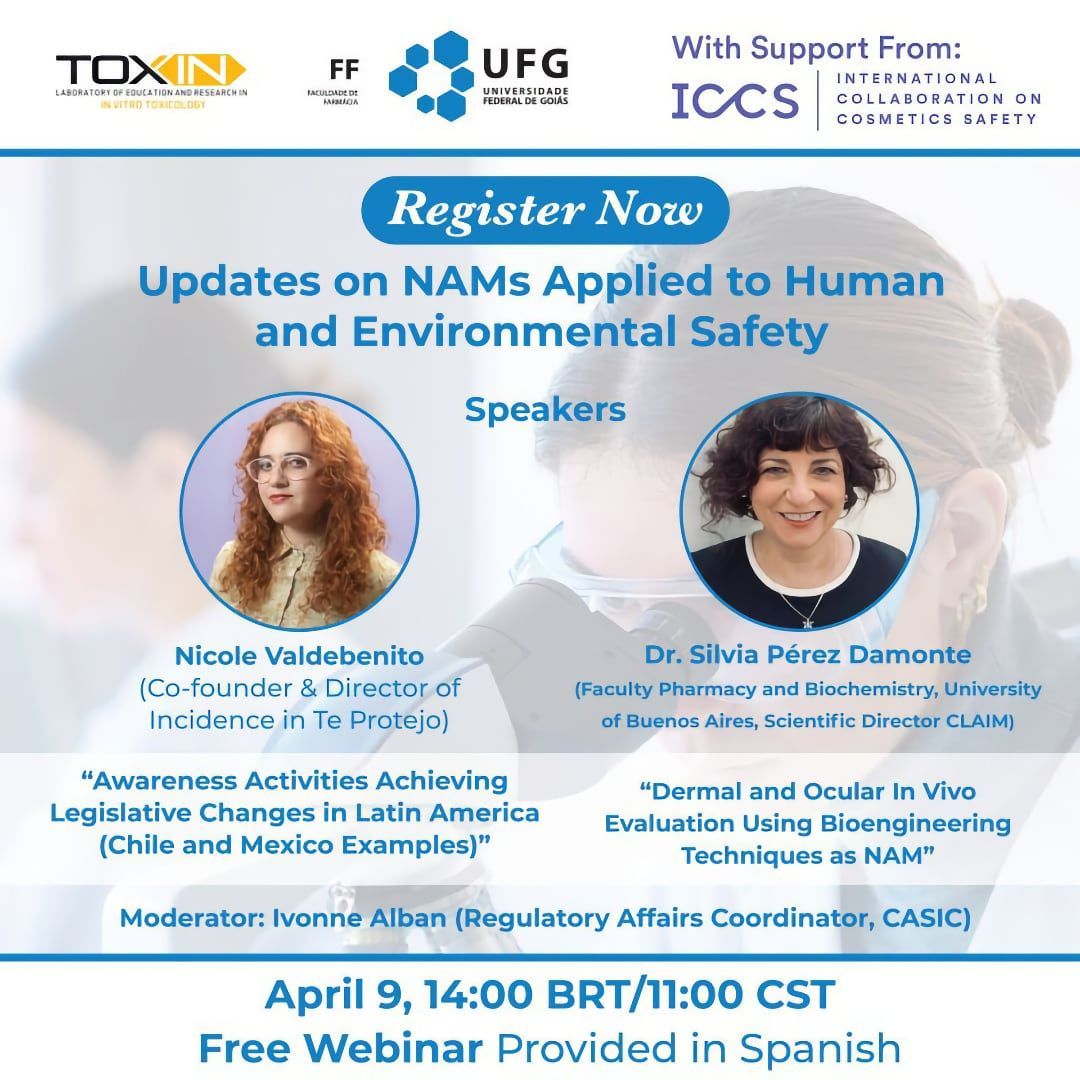
ICCS, in collaboration with Universidade Federal de Goiás Faculty of Pharmacy (FF/UFG) and Tox In Laboratory of Education and Research in In Vitro Toxicology will be presenting the fifth webinar in the monthly series, “Updates on New Approach Methodologies (NAMs) Applied to Human and Environmental Safety.”
This free webinar will be presented in Spanish on April 9, 14:00 Brasília/Brazil time or 11:00 Mexico City/Mexico.
Speakers:
- Nicole Valdebenito (Co-founder & Advocacy Director in Te Protejo)
Presenting: “Awareness Activities Achieving Legislative Changes in Latin America - Chile and Mexico examples” - Dr. Silvia Perez Damonte (Faculty Pharmacy and Biochemistry, University of Buenos Aires, Scientific Director CLAIM)
Presenting: “Dermal and Ocular In Vivo Evaluation Using Bioengineering Techniques as NAM”
Moderated by:
Ivonne Albán (Regulatory Affairs Coordinator, CASIC)
Experts and non-experts on NAMs from academia, industry, and regulatory industries are welcome to join.

ICCS is delighted to welcome the China Association of Fragrance, Flavour and Cosmetic Industries (CAFFCI) as a member of ICCS. This milestone reflects the strong and growing commitment shared by ICCS and CAFFCI to advancing animal-free safety assessment through scientific collaboration, innovation, and international partnership. Building on the ICCS–CAFFCI Memorandum of Understanding, our organizations are already working together to expand access to ICCS Best Practice Guidance documents within China, supporting the broader adoption of modern, science-based, animal-free approaches to cosmetic and personal care product safety assessment. We are honored to deepen our collaboration with CAFFCI and look forward to the continued progress that can be achieved together in strengthening global best practices and advancing the future of animal-free safety science.
We’re excited to share that the ICCS 2025 Annual Report is now available, highlighting a year of strong momentum driven by the expertise, engagement, and collaboration of our global membership. In 2025, ICCS members across industry, alongside partner organizations and trade and research associations, continued advancing animal-free safety science through practical tools, scientific outputs, and meaningful engagement with the regulatory community. What stands out most is the scale of this collective effort, turning innovation into real-world frameworks and global dialogue that support regulatory progress. Read the full report

The International Collaboration on Cosmetics Safety (ICCS) today announced the election of its 2026 Board officers, confirmed at the organization’s December 2025 Board meeting. The newly elected leadership reflects ICCS’ continued commitment to advancing approaches in animal-free cosmetics safety.